Chlorite, Hematite, Limonite, Kaolinite: A Mineralogist's Guide to the Four-Season Phantom Quartet (and How to Wear One in 2026)
Four inclusions, four seasons, four elements. What sits inside the sphere is not decoration—it is a record of the hydrothermal fluid that paused, dropped its load, and started growing again.
KEY TAKEAWAYS · EXECUTIVE SUMMARY
- ✦A phantom is a growth interruption, not a painting: a coating of mineral dust settles on a quartz crystal face during a pause in growth, and a later pulse of silica-saturated fluid seals it inside as a ghost outline of the earlier crystal.
- ✦Our four house stones are distinguished by their inclusion species: chlorite (green Mg-Fe phyllosilicate, Wood), hematite (Fe2O3, Fire), limonite (a field term for hydrated iron oxides, chiefly goethite, Earth), and kaolinite (white Al-clay from feldspar weathering, Metal and Water).
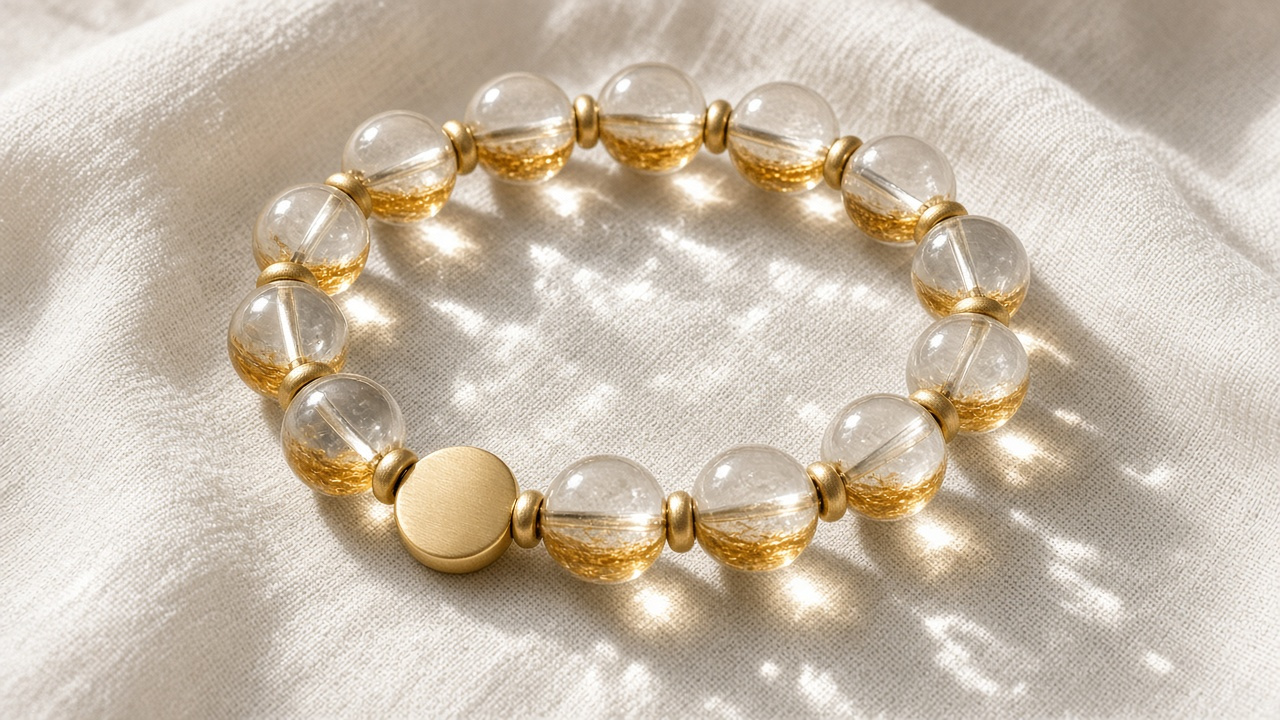
- ✦The collector grade is the 70/30 Ju Bao Pen: the upper 70% of the sphere is optically water-clear rock crystal (Mohs 7.0, refractive index 1.544), the lower 30% holds a settled three-dimensional mineral basin.
- ✦In the 2026 Bing Wu Fire Horse year the prescription is thermal: Wood types need replenishing, Fire types need either kindling or cooling depending on birth season, Earth types need the crucible, and Metal and Water types need to be shielded from the forge.
What a Phantom Actually Is: A Growth Interruption, Not a Painting
Quartz grows when silica-saturated fluid moves through a cavity and deposits silicon dioxide onto an existing crystal. If growth pauses—because the fluid chemistry shifts, the temperature drops, or a pulse of mineral-rich water arrives—a fine coating settles on the crystal's faces. When clear quartz resumes, it seals that coating inside as a ghost outline of the shape the crystal used to be. That outline is a phantom.
This is why a genuine phantom has depth and stratigraphy. Under magnification you are not looking at colour in a crack; you are looking at one growth episode lying on top of another, separated by an interface you can focus through. GIA's Gems & Gemology Microworld column has documented quartz phantoms formed from a wide range of species—wurtzite, chlorite, hematite among them—and the geometry is always the same: an earlier crystal shape preserved inside a later one.
The host is unremarkable and that is the point. Rock crystal quartz is SiO2, Mohs hardness 7.0, refractive index 1.544 to 1.553, specific gravity about 2.65. It is hard enough for daily wear, chemically inert against skin and perfume, and optically clear enough to act as a lens over what it contains. Everything interesting in these stones is inclusion mineralogy; the quartz is the vitrine.
Why Natural Phantoms Never Repeat
Growth pauses are local events. Two spheres cut from the same pocket may share a colour family, but the terrace lines, moss density and basin contour will never match, because the fluid that paused did so differently for each crystal. Identical internal scenery repeated bead after bead is the single strongest tell of a molded or dyed imitation.
Chlorite · Spring Moss Phantom (Wood 木)
Chlorite is a group of green magnesium-iron-aluminium phyllosilicates that form during low-grade metamorphism and hydrothermal alteration of ferromagnesian minerals. Inside quartz it deposits as soft green moss, fern and forest-floor textures, and we read it as Wood.
Chlorite is soft—Mohs around 2 to 2.5 as a free mineral—which is exactly why it is safe here: it is entombed inside quartz that never lets anything touch it. Visually it is the least aggressive of the four inclusions. It rarely forms hard geometric plates; it forms dithering, low-relief clouds that read as ground cover rather than as architecture, and it sits most convincingly in the lower third of a sphere where gravity would have put it.
In the seasonal system, chlorite is Wood: upward expansion, early growth, the element that spends itself to feed what follows. A Wood Day Master (Jia or Yi) in 2026 is the person most likely to be drained, because Wood feeds Fire and this year is the most Fire-saturated combination in the sixty-year cycle. Spring Moss is the replenishing stone for that chart—not because it promises anything, but because the classical reading says a Wood self being consumed needs Wood restored.
Hematite · Summer Ember Phantom (Fire 火)
Hematite is iron(III) oxide, Fe2O3, Mohs 5.5 to 6.5, the same mineral that gives red ochre its colour. It precipitates under oxidizing conditions, and inside quartz it appears as crimson plates, sunset dust and rust-red dendritic flashes. We read it as Fire.
The diagnostic detail is the streak: massive hematite looks steel-grey to black in hand specimen but always draws a red streak on unglazed porcelain. That contradiction—grey mineral, red powder—is what separates it from the iron hydroxides it is often confused with, and it is why Summer Ember spheres read deep and metallic in some lights and warm terracotta in others.
Fire is the trickiest of the four prescriptions because 2026 already supplies an excess of it. Bing Wu is Yang Fire over the midsummer Horse branch: fire set upon fire. A cold winter-born Fire Day Master genuinely benefits from Summer Ember, because the year is doing work her chart has been waiting for. A summer-born Bing or Ding Fire Day Master is already at temperature, and adding hematite is adding accelerant. For that chart the prescription flips to Winter Frost or Autumn Amber. The birth season decides, which is why we ask for the whole date rather than the year.
Limonite · Autumn Amber Phantom and the Ju Bao Pen (Earth 土)
Limonite is not a single mineral but a field term for mixtures of hydrated iron oxides, chiefly goethite (α-FeOOH), often with lepidocrocite and jarosite. It forms by weathering of iron-bearing minerals and deposits as golden-brown to ochre sediment, which is why it settles. We read it as Earth.
The settling behaviour is the whole commercial and aesthetic story. Hydrated iron oxide precipitates out of standing fluid as fine sediment and collects at the bottom of a cavity the way silt collects in a basin. Cut a sphere so that sediment occupies the lower 30% and you get the form Eastern collectors call Ju Bao Pen (聚宝盆), the treasure basin: a clean, three-dimensional landscape pooled along the base under an optically pure dome.
Two honest caveats are worth stating. First, the name is a naming and aesthetic tradition within Chinese collector culture, describing where the mineral sits in the cut stone; we sell the geometry and the material, and we make no claim that owning one produces wealth. Second, because limonite is a field term rather than a species, an authenticity card that names it precisely is doing real work—ask any seller whether the golden inclusion in their bead is goethite, and whether they have tested it at all.
Why Earth Is the Bridge Element in a Fire Year
In the generating cycle Fire produces Earth. A year as hot as 2026 hands you momentum; Earth is the crucible that receives it and holds it instead of letting it burn off. Autumn Amber is therefore the stone most often prescribed as the Treasury component of an 18-sphere ratio, whatever the Day Master's own element turns out to be.
Kaolinite · Winter Frost Phantom (Metal 金 and Water 水)
Kaolinite is Al2Si2O5(OH)4, a white clay mineral produced largely by hydrothermal alteration and weathering of feldspar. Inside quartz it forms milky white mist, snow-field washes and soft peak outlines. We read it as Metal and Water together.
Kaolinite is the quietest inclusion of the four and the one most often faked badly. Genuine kaolinite mist has no hard edges: it fades into the host quartz in gradations, because a fine colloidal suspension settles into clear fluid over a gradient rather than stopping at a line. Dyed or resin-filled imitations produce a white cloud with a defined boundary, which is physically wrong and immediately visible in daylight.
In a Fire year, Metal is the element under the hammer and Water is the element being boiled. Winter Frost is the thermal buffer: Metal for structural precision and clean judgement, Water for depth and stillness. It is the stone we most often prescribe to summer-born charts and to Metal and Water Day Masters who need the noise turned down rather than the volume turned up.
How to Wear a Lodolite Bracelet: Left Wrist or Right Wrist
The convention in Eastern practice is simple: the left wrist is the receiving side, worn when you want the stone to work on you; the right wrist is the outward side, worn when you are projecting into a room. It is a convention, not a rule, and there is a practical test that overrides it.
The practical test comes first, because a bracelet you take off after two days does nothing at all. If you write, drive, use a mouse or cook with your right hand, wear the bracelet on the left. Quartz is Mohs 7 and will not scratch against paper or a keyboard, but repeated impact against a desk edge or a watch clasp is how spheres chip, and the dominant hand collects those impacts. Comfort first; symbolism second.
Once comfort is settled, use the convention as a dial rather than a law. Wear it on the left during the working week, when the reading is being applied to you, and move it to the right for an evening or a negotiation, when you are the one being read. Some clients simply alternate by season. None of this is medical advice and none of it changes the material; it is a way of making a piece of jewelry carry a decision you already made.
One care note that is not a convention: clean with lukewarm water and a drop of mild soap, dry with the supplied suede cloth, and keep the piece away from ultrasonic cleaners, perfume and chlorine. The quartz is indifferent to all of it; the 2.5-micron 18K champagne gold vermeil over S925 is not.
2026 Bing Wu: Matching the Four Minerals to Your Day Master
2026 is Bing Wu (丙午), Yang Fire over the Fire Horse branch, the hottest pairing in the sixty-year cycle. The prescription is thermal rather than symbolic: cool what is burning, kindle what is freezing, and give Earth the job of holding whatever the year produces.
Start from the Day Master, the Heavenly Stem of the birth day, and then correct it by birth season. A Jia or Yi Wood Day Master is being consumed as fuel this year and needs Spring Moss replenishment with Water support. A Bing or Ding Fire Day Master splits in two: winter-born Fire can carry Summer Ember and should, summer-born Fire should move to Winter Frost or Autumn Amber. Wu and Ji Earth Day Masters are fed by the year and mainly need Wood to keep the crust from compacting. Geng and Xin Metal Day Masters are in the forge and need the Metal-Water buffer. Ren and Gui Water Day Masters are being contested by Fire and need Metal to generate the well back.
Then translate the prescription into hardware. A bracelet lets you carry a four-part ratio: a Primary Balancing stone (10 spheres), a Generative Bridge stone (4), a 2026 Treasury stone (3) and a Natal Harmony stone (1)—eighteen 8mm spheres in total, strung on Japanese elastic with brushed champagne spacers. A necklace carries one thing only, so we make that one thing count: a 12mm Collector Focal Orb with 3.4× the crystal volume of an 8mm bead, cut from the <0.5% of rough that yields an unfractured 70/30 core. Both are S925 with 2.5 microns of 18K champagne gold vermeil, and both carry the Day Pillar cipher on the reverse, in the form 'GENG CHEN · 2026 · S925 AU750'.
Whatever you choose, verify it yourself before you trust it. Our 3-Second Authenticity Bench shows the comparison side by side: a genuine 70% water-clear dome projects bright optical caustics onto the surface beneath it when side-lit by a window, while dyed crackle glass casts flat muddy shadows and shows round gas bubbles under a loupe. Natural inclusions have grain and depth; dye pools along fractures and has neither. And a note on claims: these pieces are sold as jewelry and personal symbolism, with the geology and the classical timing system described accurately—we make no medical, therapeutic or financial-outcome claims.
Four-Season Phantom Quartet: Inclusion Mineral, Formation and 2026 Bing Wu Role
| Four-Season Phantom | Inclusion Mineral & How It Formed | Element, Season & Role in 2026 Bing Wu |
|---|---|---|
| Spring Moss Phantom | Chlorite — green Mg-Fe-Al phyllosilicate from low-grade metamorphism and hydrothermal alteration of ferromagnesian minerals; soft low-relief moss, Mohs ~2–2.5 as a free mineral, safe because entombed in Mohs 7 quartz | Wood 木 · Replenishes Jia and Yi Wood Day Masters who are being consumed as fuel by the hottest year in the cycle |
| Summer Ember Phantom | Hematite — iron(III) oxide Fe2O3, Mohs 5.5–6.5, precipitates under oxidizing conditions; steel-grey in mass with a diagnostic red streak, appearing as crimson plates and sunset dust | Fire 火 · Kindles cold winter-born Fire charts; contraindicated for summer-born Bing and Ding Fire, which are already at temperature |
| Autumn Amber Phantom | Limonite — a field term, not a species: hydrated iron oxides chiefly goethite (α-FeOOH) formed by weathering of iron-bearing minerals; settles as golden-brown sediment, creating the 70/30 Ju Bao Pen basin | Earth 土 · The crucible that receives 2026 Fire and holds it; the Treasury component in most 18-sphere ratios |
| Winter Frost Phantom | Kaolinite — Al2Si2O5(OH)4 white clay from feldspar alteration and weathering; colloidal mist that fades into the host quartz in gradients, never at a hard boundary | Metal 金 and Water 水 · Thermal buffer for Metal under the forge and Water under evaporation; the standard cooling prescription for summer-born charts |
Frequently Asked Questions
What is the difference between Lodolite, garden quartz and phantom quartz?
They overlap heavily. Phantom quartz is the geological term: a crystal containing the ghost outline of an earlier growth stage, sealed inside by later clear quartz. Lodolite and garden quartz are trade names, used mostly in the bead market, for quartz whose phantoms contain scenic chlorite, hematite, limonite or kaolinite inclusions. All AURA & PHANTOM spheres are natural untreated phantom quartz graded to the 70/30 half-basin standard.
Should I wear my Lodolite bracelet on the left or right wrist?
Wear it on the non-dominant wrist first, because that is the one that will survive desks, keyboards and watch clasps. Then use the Eastern convention as a dial: left is the receiving side, worn when the reading is being applied to you; right is the outward side, worn when you want the piece to read as part of how you present. It is a convention rather than a rule, and it is not medical advice.
How do I tell whether my bracelet is genuine 70/30 phantom quartz or dyed glass?
Three checks take about three seconds. Side-light the sphere at a window: a genuine 70% water-clear dome acts as a lens and throws bright optical caustics onto the surface beneath, while glass throws a flat shadow. Look at the inclusion boundary: natural chlorite, hematite, limonite and kaolinite have grain, depth and gradient; dye pools along fractures. And look for round gas bubbles, which no hydrothermal crystal contains. Our 3-Second Authenticity Bench shows all three comparisons side by side.
2026 BING WU FIRE HORSE · BESPOKE ATELIER
Calculate Your Solar Four Pillars & Preview Your Talisman
See whether your chart calls for Spring Moss, Summer Ember, Autumn Amber, or Winter Frost—and preview our 12mm High-Grade Focal Orb ($129) or 18×8mm Petite Wrist Bracelet ($139) in 60 seconds with no sign-up.
Continue Reading in The Atelier Journal
2026 BaZi Monograph
The 2026 Fire Horse Elemental Guide: Bing Wu, the Five Elements & the Seasonal Lodolite That Balances You
Read Monograph →
Metaphysical Architecture
Why Your 1912 Department-Store Birthstone Is Wrong: Eastern Four-Pillar (BaZi) Day Masters Explained
Read Monograph →
Gemological Lab
70/30 'Ju Bao Pen' Garden Quartz vs. Dyed Crackle Glass: A Collector's Gemological Field Guide
Read Monograph →
Atelier Design & Proportion
12mm Collector Focal Orb vs. 18×8mm Petite Wrist Spheres: The Geometry, Volume & Price Anchoring of High-Grade Lodolite
Read Monograph →
2026 BaZi Monograph
Born in 1988, 1990, or 1994? How the 2026 Bing Wu Fire Horse Reads Your Four Pillars (And Why Birth-Month Stones Miss It)
Read Monograph →
Metallurgy & Provenance
2.5-Micron 18K Champagne Gold Vermeil vs. Brass Gold-Plated: The Metallurgy Behind Heirloom BaZi Talismans
Read Monograph →
Metaphysical Architecture
A Meaningful Birthday Gift That Is Not a Birthstone: Custom Birth-Chart Jewelry Built From Her Exact Four Pillars
Read Monograph →